
.jpg)
I came to golf later in life after competing as a Division I athlete in cross country, and later soccer. In those sports, the formula felt pretty straightforward: train hard, do the drills, put in the miles and get better.
Golf, apparently, did not get that memo.
You can practice, take lessons and finally feel like something is clicking. Then you step onto the course and hit two completely different shots with what felt like the exact same swing.
For someone who is competitive, process-driven and accustomed to seeing hard work pay off, this is, to put it mildly, maddening.
So why does golf get into our heads so easily? And more importantly, how can we get better at the mental game of golf without turning every round into a therapy session?
Table of Contents
- Stop Letting Every Shot Define You
- Three Things You Can Actually Control
- How To Stop Overthinking Your Golf Swing
- How To Mentally Recover After a Bad Shot
- A Good Mental Routine For Golf
- What If Positive Thinking Feels Fake?
- How To Find The Right Mental Performance Support
- The Only Shot That Matters Now
- Mental Game FAQ's
According to Dr. Deborah Graham, a licensed counseling and sport psychologist specializing in golf performance, part of the answer is surprisingly simple: golf gives us way too much time to think.
“You have a whole lot of time between shots to think,” Graham told me. “And then, I would say next to that would be the ball just sitting there.”
%20(1).jpg?width=552&height=310&name=65%20-%20Testimonials%20750x580%20(Website)%20(1).jpg)
There it is. The ball just sits there, looking completely innocent while our brains run through 47 swing thoughts, replay the double bogey from three holes ago and calculate a score we promised ourselves we were not tracking.
Golf may be played on a course, but plenty of the action happens between your ears.
And the mental game is not just for Tour professionals or elite competitors. Whether you are trying to win a championship, break 100 or simply stop apologizing to your playing partners after every bad shot, learning to manage your thoughts can help you play better and enjoy golf more.
Why Is Golf So Mentally Challenging?
The ball is not moving. Your brain is.
A round of golf can take longer than a Michigan football game, but only a small percentage of that time is spent actually hitting shots. The rest is filled with walking, waiting, chatting, thinking and, if you are anything like me, occasionally spiraling.
Graham compares golf with more reactive sports. If a tennis ball is flying toward you at 70 miles per hour, you do not have time to consciously direct every part of your body. You react.
The golf ball gives you no such favor.
It sits there while you think about your grip, takeaway, backswing, score, playing partners, the bunker guarding the green and whether you have suddenly forgotten how to play golf altogether.
“You literally have to discipline your mind and put it in a place to react,” Graham said.
That mental space reveals a lot about us. Are we patient? Can we focus? How do we respond when something goes wrong? Can we make a decision and actually trust it?
Golf has a funny way of finding every tiny crack in your confidence, then handing you a scorecard so you can document the experience.
Stop Letting Every Shot Define You
Most golfers judge a shot by one thing: where the ball finishes.
Fairway? Great shot.
Trees? Terrible shot.
Cart path? Let’s never speak of it again.
The problem is that we can’t control everything that determines the result. There is no way to regulate every bounce, lie, gust of wind or unpredictable reaction when the ball lands. You can make a smart decision and execute a committed swing, only to get an imperfect result.
“If you’re judging yourself by the result of your shot, it’s going to be a rough day,” Graham said. “Because you can’t control very much.”
That does not mean your score is meaningless, especially if you are competing or tracking improvement. But when every shot becomes a referendum on your entire golf game, confidence disappears fast.
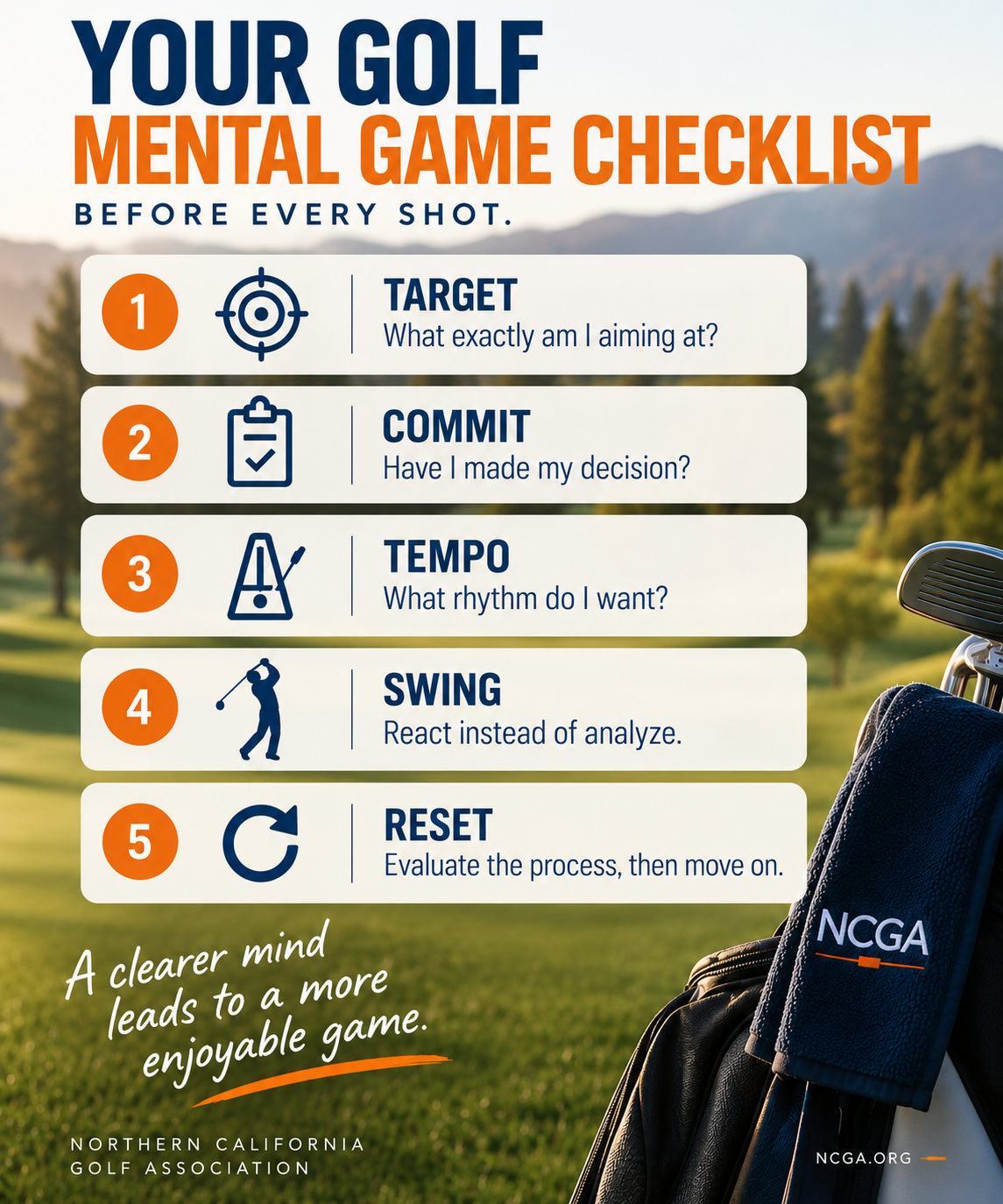
Graham encourages golfers to shift their attention from outcome to process. Before immediately asking where the ball went, take a second to evaluate what happened before and during the swing.
Did I choose a definite target?
Was I committed?
Did I maintain my tempo?
Those questions give you something useful to carry into the next shot. They also stop one bad swing from turning into a full-blown personality crisis.
Three Things You Can Actually Control
A productive mental routine does not need to be long, complicated or worthy of its own laminated instruction manual. Graham recommends focusing on three controllable elements.
Pick a Target
Choose a specific target instead of aiming vaguely toward the fairway or green. Pick a tree, the edge of a bunker or an exact landing area.
“Somewhere over there” is not a target. Give your brain a clear assignment.
Make the Decision
Once you have selected the club and shot, commit to it. Standing over the ball is not the time to reopen negotiations.
Choose it. Trust it. Hit it.
Find Your Tempo
Focus on maintaining the rhythm you intended. Tempo is a simple physical cue that keeps your brain from introducing six new swing thoughts during the two seconds it takes to hit the ball.
For beginners and juniors, Graham simplifies the routine even further with T&T: definite target and great tempo.
“This builds consistency and keeps the mind from jumping around,” she explained.
The goal is not to guarantee a perfect shot. Golf would never make it that easy. The goal is to build a process you can repeat, even when the result is less than Instagram-worthy.
How Do You Stop Overthinking Your Golf Swing?
Thinking before a shot is not automatically a problem. Golf requires decisions about the club, target and type of shot you want to play.
The trouble starts when the decision-making refuses to end.
Graham describes a useful pre-shot thought as simple, decisive and temporary. First, analyze the situation and commit to the club, target and shot. Then move into visualization and feel.
Technical overthinking keeps reopening the decision. It adds swing mechanics, introduces second-guessing and tries to control several body parts at once.
“If the thought continues once you’re over the ball or during the swing, it’s overthinking,” Graham reiterated.
When that happens, return to your routine and choose one clear feel thought. Something as simple as “smooth back, smooth through” can give your brain direction without turning the swing into a complicated checklist.
A useful thought helps you make a decision. Overthinking makes you question it six more times.
How to Mentally Recover After a Bad Golf Shot
The next time you hit a shot you don’t like, resist the urge to criticize your swing, declare the round ruined or apologize to everyone within earshot.
Instead, ask yourself three questions:
- Did I have a definite target?
- Was I fully committed?
- Did I maintain a good tempo?
Choose one adjustment for the next shot, state it once and move on.
That last part matters. Move. On.
Graham emphasizes that our words and thoughts can either protect our confidence or slowly chip away at it. Repeatedly apologizing for perfectly normal bad shots keeps your attention fixed on the result and on what everyone else might be thinking.
Here is the good news: most golfers are far too busy analyzing their own games to conduct a detailed investigation into yours.
Your next shot does not need a complete review of everything that has gone wrong. It needs a target, commitment and tempo.
What Is a Good Mental Routine for Golf?
Every golfer brings a different personality, experience level and purpose to the course. That means the most helpful mental exercise won’t look exactly the same for everyone.
A beginner may benefit from keeping the routine as simple as T&T. Pick the target, find the tempo and swing.
A competitive golfer may need a more defined three-step routine: analyze and commit, visualize the shot, then feel the swing. Deep abdominal breathing between shots can also help manage tension and reset focus under pressure.
A high achiever can put all that ambition to better use by writing down three process goals before the round. Those might include committing to every club selection, following the same routine on every shot and judging the process instead of the outcome after a mistake.
A social golfer can use T&T over the ball, then widen their focus and enjoy their friends between shots. You are allowed to care about your golf and still laugh your way around the course.
A woman working through confidence or belonging barriers may benefit from visualizing controllable signs of confidence before the round. Picture yourself walking with purpose, selecting definite targets and maintaining steady tempo, regardless of where the previous shot finished.
For junior golfers, the best starting point may be the simplest one: play one shot at a time and evaluate the process after every shot, good or bad.
There is no universal mental routine. The right one is the routine that gives you a clear job and helps you come back to the present.
What If Positive Thinking Feels Fake?
Affirmations and gratitude can be useful between shots, but sometimes positive thinking feels a little forced, especially when your round is going sideways.
Graham says that can be a sign you are carrying too much tension. Instead of trying even harder to convince yourself that everything is wonderful, slow down and focus on something real.
Notice the coolness of the water you are drinking. Tip your face upward and feel the warmth of the sun or focus on the solid ground beneath your feet. Take a deep breath and picture a place where you naturally feel relaxed.
This sensory reset is not about pretending the previous shot did not bother you. It simply gives your brain somewhere calmer and more productive to go.
You do not need to become the world’s most positive person before reaching the next tee. You just need to stop dragging the last shot there with you.
Finding the Right Mental-Performance Support
Golfers looking for professional help should start by considering what kind of support they need.
Serious competitors seeking individualized performance support may want to look for a licensed psychologist or comparable mental-health professional with specific experience and research in golf or sport performance.
A social or recreational golfer who primarily wants to improve focus, relaxation and enjoyment may also benefit from a qualified mental-performance coach with credible sport-psychology training and golf-specific experience.
Before choosing someone, ask about their education, credentials, experience with golfers at your level and the research behind their approach. It is also important to understand the difference between performance coaching and mental-health treatment.
Graham is a licensed counseling psychologist specializing in golf performance and the author of The Eight Traits of Champion Golfers. According to her GolfPsych biography, she has worked with almost 400 players across the PGA, LPGA and Champions Tours, including 21 players she helped guide to 31 major championships.
The Only Shot That Matters Now
Golf will always produce unpredictable results. That’s part of what makes the game maddening, fascinating and somehow impossible to quit.
The goal of the mental game is not to eliminate frustration, pretend every shot was great or become so calm that you stop caring. It’s to have a reliable place to return when a shot doesn’t go the way you hoped.
For your next round, try grading yourself on something other than your score. Count how many shots included a definite target and committed tempo. Notice how quickly you return to the present after a mistake.
You can’t control every bounce, lie or outcome. But you can control the job you give your mind before the next swing.
At the NCGA, we want golf to feel like a game you belong in, whether you are competing for a championship, learning the basics or squeezing in nine holes with friends. A stronger mental routine can give you more confidence, more enjoyment and, hopefully, fewer moments spent wondering why you voluntarily play this ridiculous and wonderful game.
Because the last shot is over.
The next one is yours.
Golf Mental Game FAQs
Put it into practice: Take T&T to the course during your next round. Pick a definite target, commit to your tempo and see how many shots you can grade by your process instead of your score.
What kind of mental golfer are you? Follow along and find your mental golfer match!