

Don’t Let a Few Bad Holes Stop You from Getting a Handicap Index
One bad hole doesn’t mean you can’t establish a Handicap Index®.
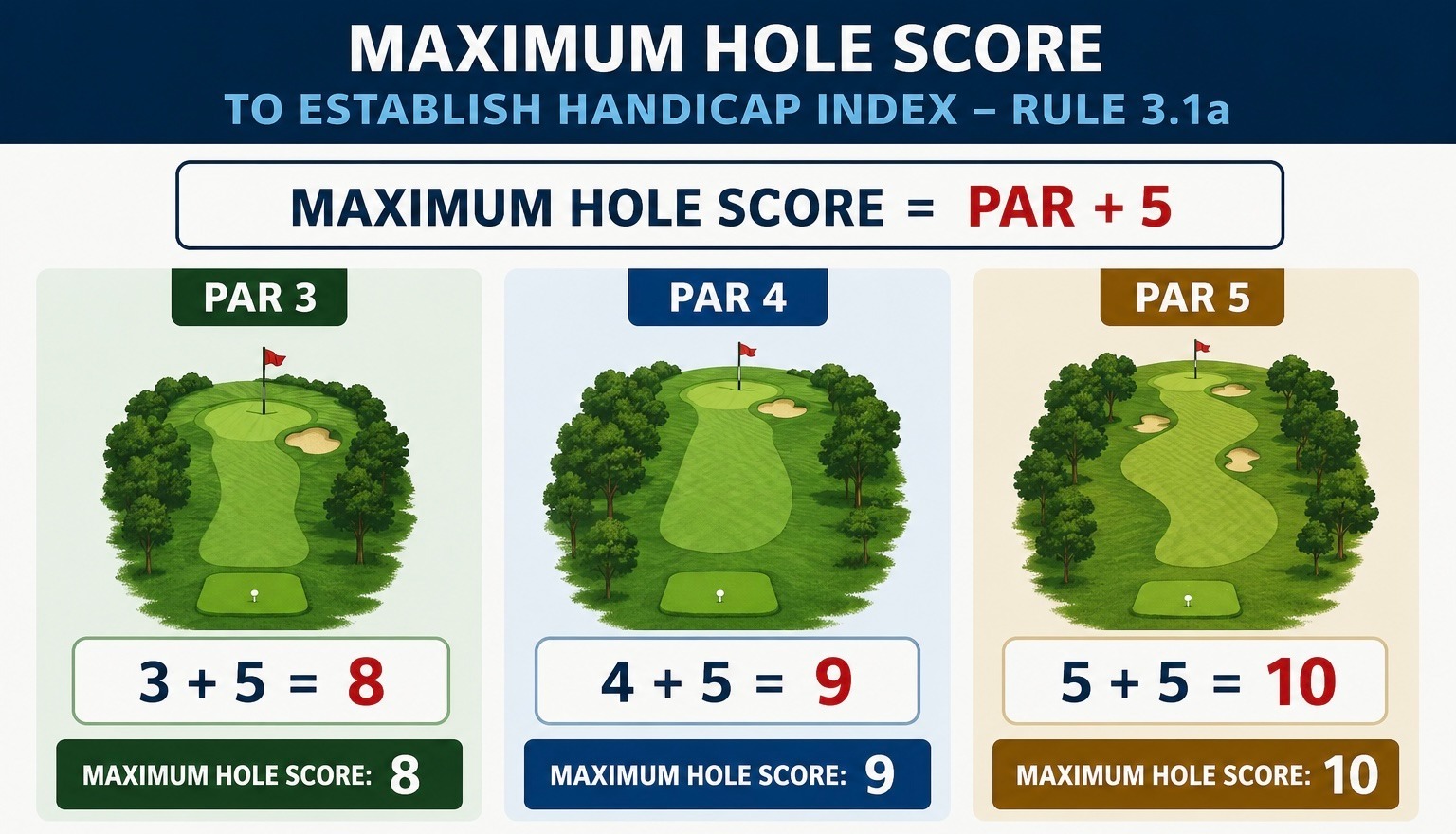
If you’re posting scores to establish your initial Handicap Index, the maximum score you can post for handicap purposes on any hole played is Par + 5. That means the maximum is 8 on a par 3, 9 on a par 4, and 10 on a par 5.
The World Handicap System™ accounts for difficult holes, and understanding how the Par + 5 Rule works can help you start posting scores with confidence.
What You'll Learn
- What Is the Par + 5 Rule for Establishing a Handicap Index?
- When Does the Par +5 Rule Apply?
- What Changes After Your Handicap Index Has Been Established?
- How Do You Calculate Par +5 on a Par 3, Par 4, or Par 5?
- Summary
- Frequently Asked Questions
Can a Bad Hole Prevent You from Getting a Handicap Index?
We've all been there.
Your tee shot finds a tree. Your next shot lands in a bunker. Then comes a penalty area, another difficult shot and a few putts you would rather forget. For a golfer who is just beginning to post scores, a hole like that might make you think, “I guess I’m not ready for a Handicap Index.” But you don’t need to play perfect golf—or even consider yourself a “serious golfer”—to start establishing one.
When you are submitting scores to establish your initial Handicap Index, Rule 3.1a limits the maximum score for handicap purposes on each hole played to Par + 5. The rule helps prevent one unusually difficult hole from having too much influence on the scores used to establish your Handicap Index.
That means you can have a blow-up hole and keep going.
What Is the Par + 5 Rule for Establishing a Handicap Index?
Think of Par + 5 as a safety net for golfers who are establishing their first Handicap Index.
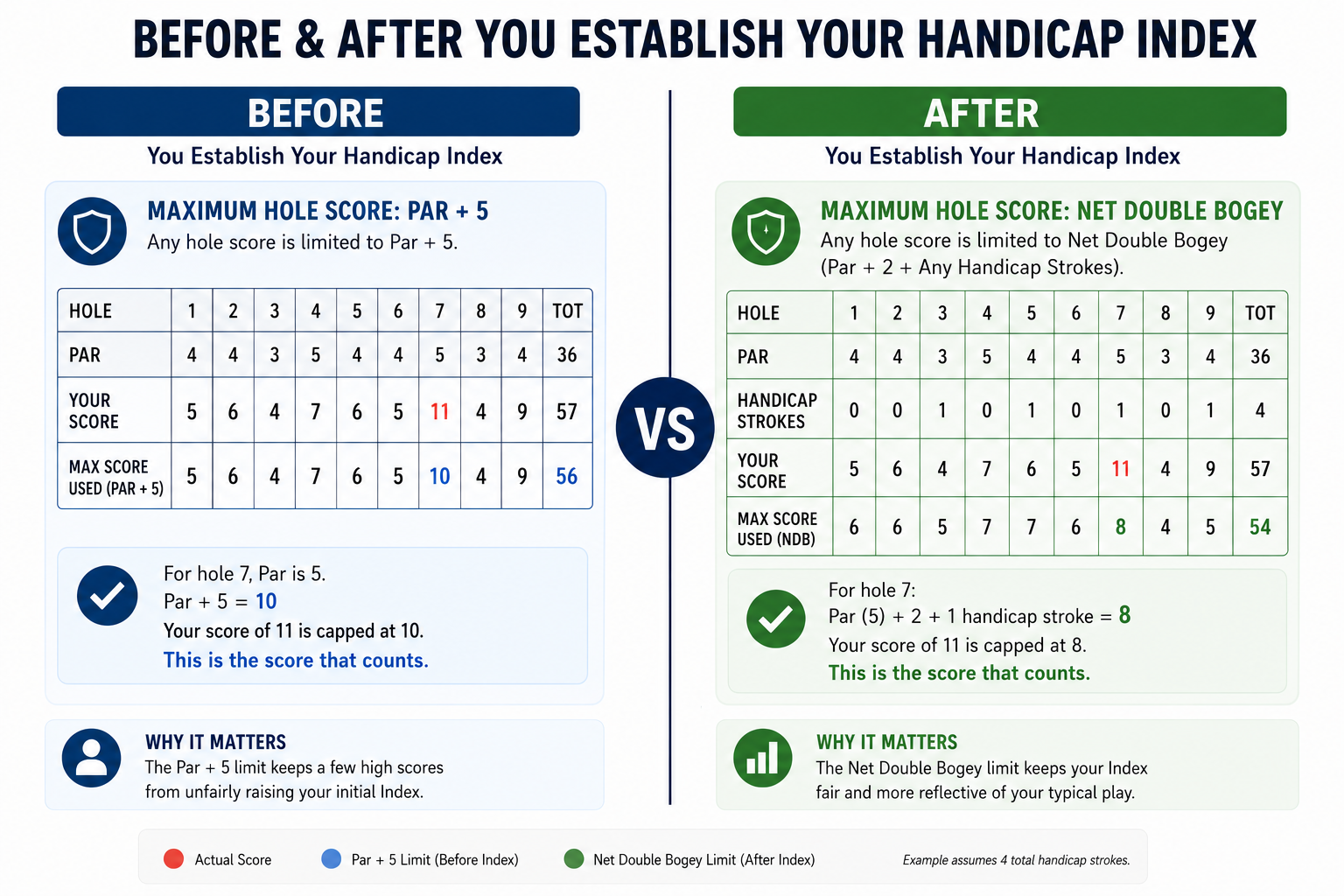
Before your Handicap Index is established, the Rules of Handicapping place a limit on how high a score can count for handicap purposes on each hole. That limit is simply the par of the hole plus five strokes.
When Does the Par + 5 Rule Apply?
Par + 5 applies when you do not yet have an established Handicap Index and are submitting scores to obtain your initial Handicap Index.
This distinction matters because the maximum-hole-score rule changes after your Handicap Index has been established.
So, when thinking about Par + 5, remember:
No established Handicap Index yet → Par + 5
Established Handicap Index → Generally Net Double Bogey
What Changes After Your Handicap Index Is Established?
After you have established your Handicap Index, your maximum hole score changes from Par + 5 to Net Double Bogey under rule 3.1b.
Net Double Bogey is calculated as = Par of the hole + 2 strokes + Any handicap stroke(s) that the player receives on that hole*
*This means the maximum score for handicap purposes may be different from hole to hole once your Handicap Index is established, because it depends on the number of strokes you receive (aka “pops” on a scorecard).
How Do You Calculate Par + 5 on a Par 3, Par 4, or Par 5?
- Par 3 → Maximum score: 8
- Par 4 → Maximum score: 9
- Par 5 → Maximum score: 10
The easiest way to understand Par + 5 is to see it in action.
Why Should I Get a Handicap Index If I’m Still Improving?
You don’t need to wait until your swing is consistent or your scores reach a certain number before establishing a Handicap Index.
In fact, if you’re working on your game, a Handicap Index can give you something valuable: a way to track your progress over time.
For an aspiring golfer, it creates a starting point. Instead of wondering whether your game is improving, you can begin seeing that progress reflected as you continue playing and posting scores.
And if you already have an NCGA membership or GHIN® number but haven’t posted enough scores to establish your Handicap Index, there’s no reason to wait for the “perfect” round.
Summary
Every golfer has a hole they would rather forget. That doesn’t mean you aren't ready to establish a Handicap Index.
"Golf may seem complicated, but calculating your maximum score shouldn't be," says Martin Fuentes, Senior Manager of Customer Service and Governance at the Northern California Golf Association.
Start posting eligible scores, establish your Handicap Index and give yourself a way to track where your game goes from here.
Everyone starts somewhere—and one bad hole doesn’t have to stop you.

Handicap 101
Have more Handicap questions?
Get answers to all your questions about golf handicaps with Handicap 101: how to calculate, establish, and utilize your Handicap Index® for fair competition and why every golfer needs one.