
This article originally appeared in the July issue of NCGA Golf Magazine
By James Raia
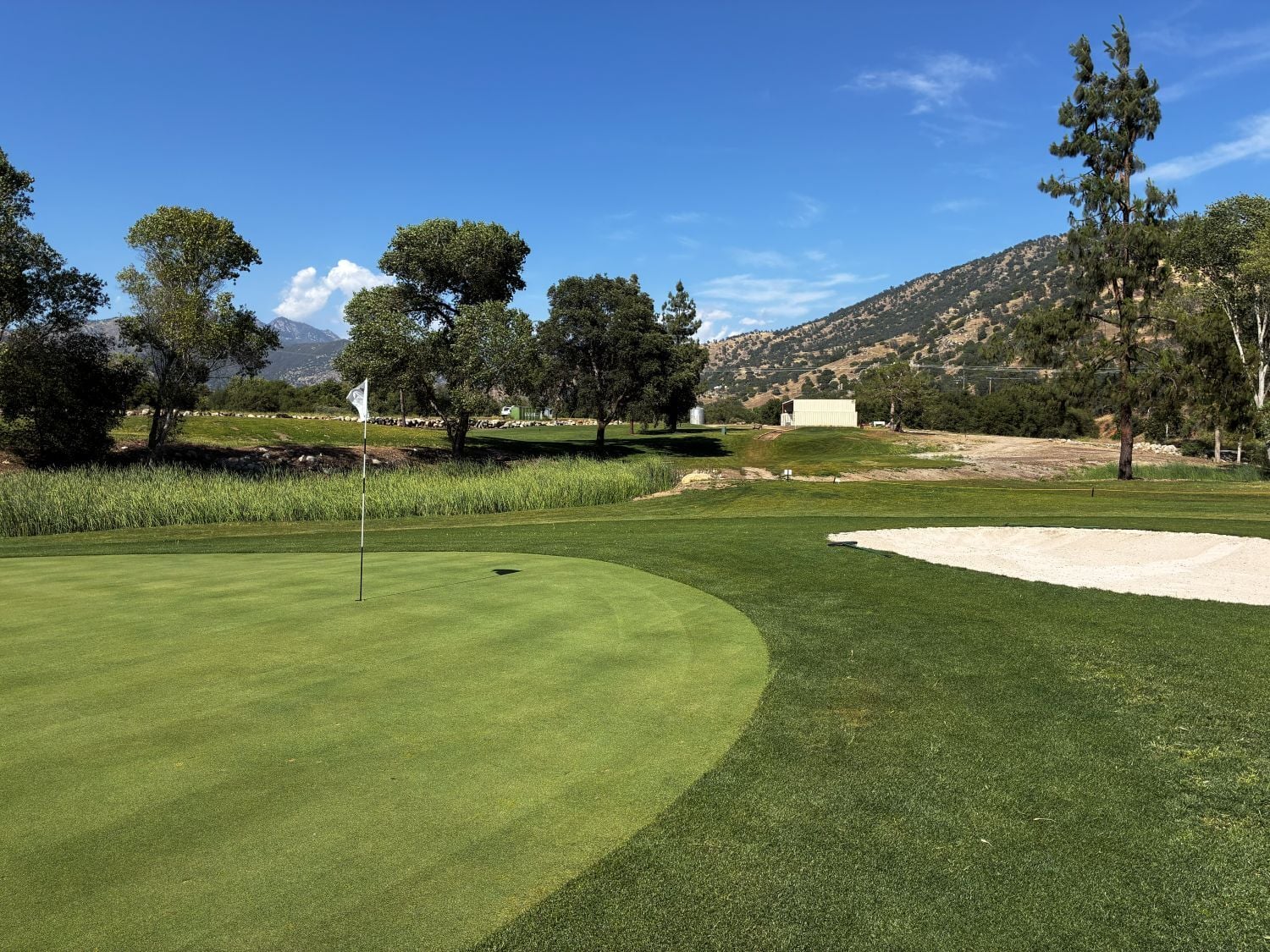
Approaching 90 years ago, Greg Dixon's grandparents purchased 114 acres in the Sierra Nevada foothills for $10,000. Three Rivers Golf Course is on the property, a family heirloom whose legacy includes several owners and decades of abandonment.
But Dixon and his wife Nataliya decided about two years ago to resurrect the dilapidated course.
"The previous owner shut it down in 2010, 2011; it was on the downhill side for a long time," Greg says. "It was dirt and weeds and gophers and squirrels. It didn't even resemble a golf course anymore. You couldn't tell a sand trap from the greena green."
The Dixons had built a home in Coeur d'Alene, Idaho, and were returning to Three Rivers often. But re-establishing a business in Greg's hometown became the priority. They now reside again in the community full-time and live in a house off the course's fifth fairway.
"When this became available, we just sold the house in Idaho to be part of this community," Nataliya says.
After an exhaustive overhaul, including a new configuration of holes, the co-owners welcomed golfers again on April 15.
Named after the North, Middle, and South Forks of the Kaweah River and the town of the same name, the facility again serves as a gateway to the world's largest trees. The entrance to Sequoia National Park is six miles northeast on Route 198. Fresno is 75 miles northwest.
"I go way back; I was born and raised on this golf course," Greg says during a recent visit. "It was built in 1960 and I was born in '58. I lived right on the second green. I took up golf as a kid. My father played. My brother played. My grandparents actually bought this property in '38. It was a ranch."
With several silent investors and consulting from Brett Miller, the general manager of Tulare Country Club, the Dixons started the renovation more than a year ago. Miller and the Dixons are now close friends.
"I always kind of wanted to get this thing back open,” Greg says. "I got some partners and got it open."
Greg was also part of an investment group in the golf course in the 1980s, but it didn't succeed. He took classes at the local junior college and then had a 30-year career in a local grocery store. It's just down the road from the golf course in the town, population 2,500. It has an annual hot dog festival and a calf roping contest. Nearby Lake Kaweah is an RV and vacation rental destination for park visitors.
The Dixons have about 50 employees. Workdays are long. Greg is usually on the course, starting before sunrise and leaving after sundown. Nataliya does a half-dozen other jobs facing golf course owners. The owner's small office is stacked with merchandise, restaurant supplies and golf equipment.
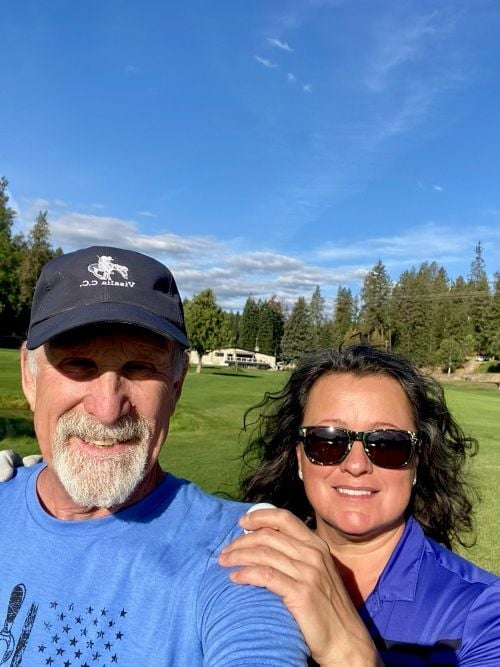
The couple met online and have been married for 25 years. Nataliya is from Ukraine and came to the United States two years after the couple began dating. She didn't play golf, didn't know much about the game and had little interest.
After trying to learn several times, Nataliya stopped. But seven years ago, a few lessons changed her approach. She is now enamored by the game. When there's a rare opportunity, the Dixons "sneak out” together and play the course they own.
"There's no time off; I haven't had a day off in two years," Greg says. Nataliya, smiling, adds: "The business is a blessing and a curse."
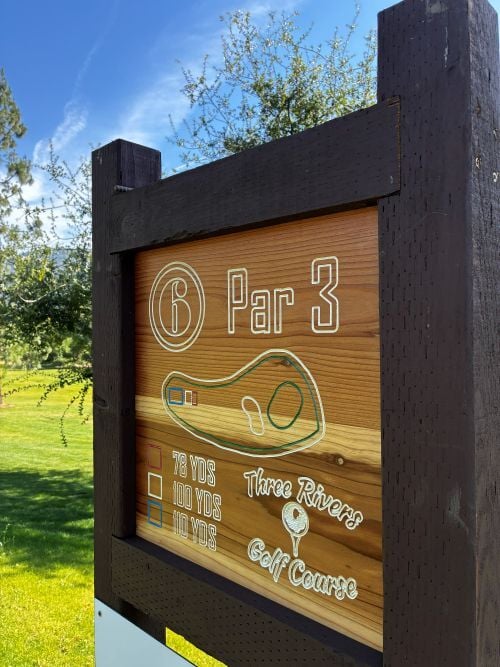
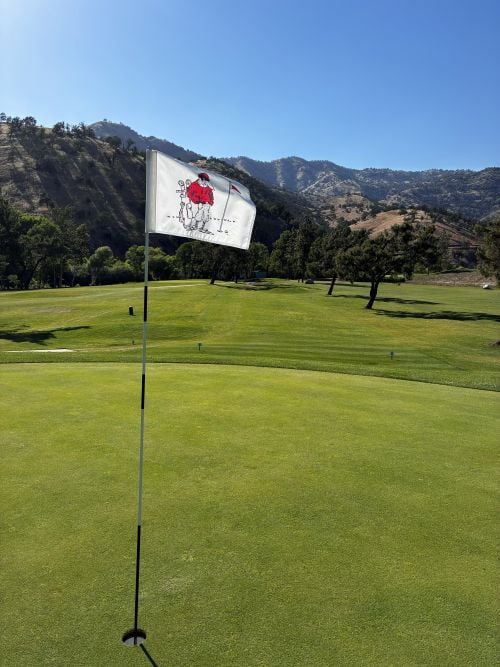
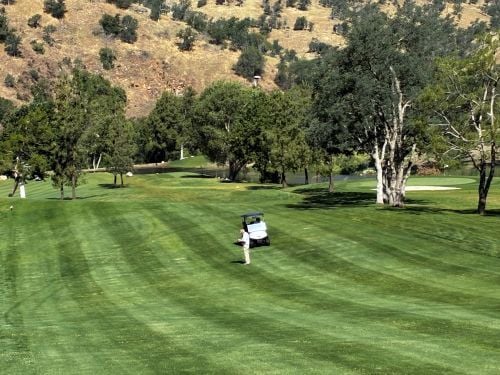
The rolling nine-hole layout's scorecard details red, white and blue tees. It has two par-5s, four par-4s and three par-3s. Yardage ranges from 2,112 to 2,627 yards, with the course playing to a par of 35. There's a limited flight chip & pitch warm-up range, with only 8 and 9-irons and wedges allowed. A paved golf path around the course was recently completed. Green fees range from $30 to $43 per nine holes. Golf cart rental is $20. Pickleball courts were also recently added.
Single monthly membership (without cart) is $200; a family monthly membership is $300. An annual single membership (without cart) is $2,200 and a family membership (without cart) is $3,300.
"There are Three Rivers locals who are playing. Of course, most of them get memberships," Greg says. "But it's mostly (golfers) from the Valley--Exeter, Visalia, Tulare. The Valley people are coming up.
"We don't have a lot of golf courses around here. But there are some. This has just turned out so well. Golf is so big now, there's enough for everybody to share the wealth."
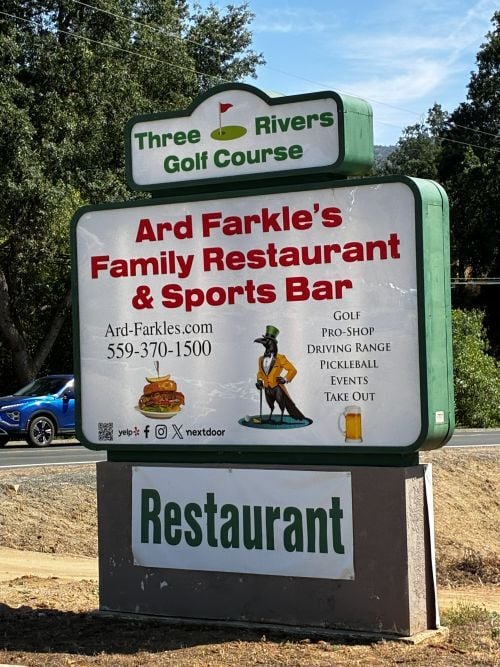
The facility also features a pro shop and Ard Farkle's Grub and Grog, a restaurant and sports bar. Its name is also part of course lore. Legend details the name was derived one evening in San Francisco during a dinner among Three Rivers locals in which alcohol was served.
The odd name also may or may not be a reference to the Common Crackle. It's sometimes called a "farkle" bird. Larger than a robin, it has a slender body and a long rudder-like tail.
Regardless, the name remains. Ard Farkle is now the course mascot. A cartoon rendering of the bird in yellow formal wear and a green top hat is imprinted on the scorecard and other items. Ard Farkle's serves a Farkle Burger and a Mother Farkle (rum and Coke).
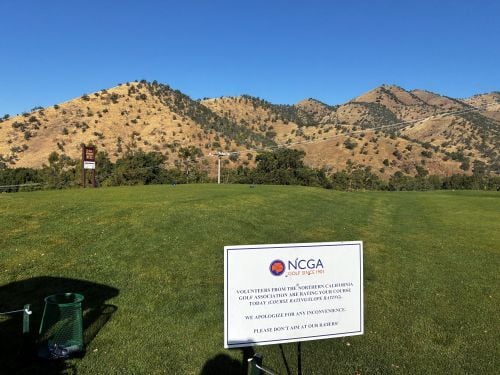
The golf course, with its "Above the Fog, Below the Snow" motto, could easily still be abandoned. Acquiring a water source was problematic.
"For 65 years, it was never a problem," Greg says. "It became a problem when we tried to reopen because it was never really permitted correctly."
Following state agency pushback, legal and political involvement and months of delays, permission with strict restrictions and regulations was approved for the use of Kaweah River water.
"We are trying to keep it alive for the summer," Greg says. "We've been using special fertilizers and herbicides and again just trying to keep it alive and so far we have. We're just pouring water into it."
Proper watering was additionally difficult because special equipment was needed to find the derelict sprinkler system.
"Our accomplishment has already been made," Greg says. "It was when we reopened the golf course. Everybody in the community wanted this.”