
This article originally appeared in the July issue of NCGA Golf Magazine
By Nick Lozito
We all have what we would call our favorite golf course, and for various reasons. Maybe it was that 5-iron shot on a par-4 that ended up dropping in for an eagle, or that it featured scenery fit for a Hollywood script. It also may have been who was alongside you, riding in the cart.
But what about some of the other parts of the round that you remember or enjoyed? Was there anything else about that particular course or facility that got your juices going or created a buzz?
Recently, it got us to wonder: What are some of the best, or most interesting, driving ranges in the NCGA region?
After some back-and-forth discussions, some searching and some coffee, we came up with some of the ranges/practice facilities that caught our attention.
In the May issue of NCGA Golf Magazine, we told you about five facilities that caught our attention.
In this issue, we present the second half of those ranges/practice facilities that we think you’d enjoy should the occasion arise.
Poppy Ridge Golf Course—Where Imagination Comes Alive
Lily Peng knew a tricky putt or delicate chip might be the difference in capturing the NCGA Women’s Amateur at Poppy Ridge. So at the recently redesigned Livermore golf course in early June, amidst the bustle of NCGA Mid-Amateur tournaments, the UCLA commit got to work.
“Just getting a feel for the greens,” said Peng, who as a junior at Carondelet High School in November won the CIF/NCGA Northern California Girls High School Championship. “I think it’s one of the best practice greens that I’ve putted on,” she said of Poppy Ridge. “It’s pretty fast and there’s decent undulations, so you can practice a bunch of different types of putts.”
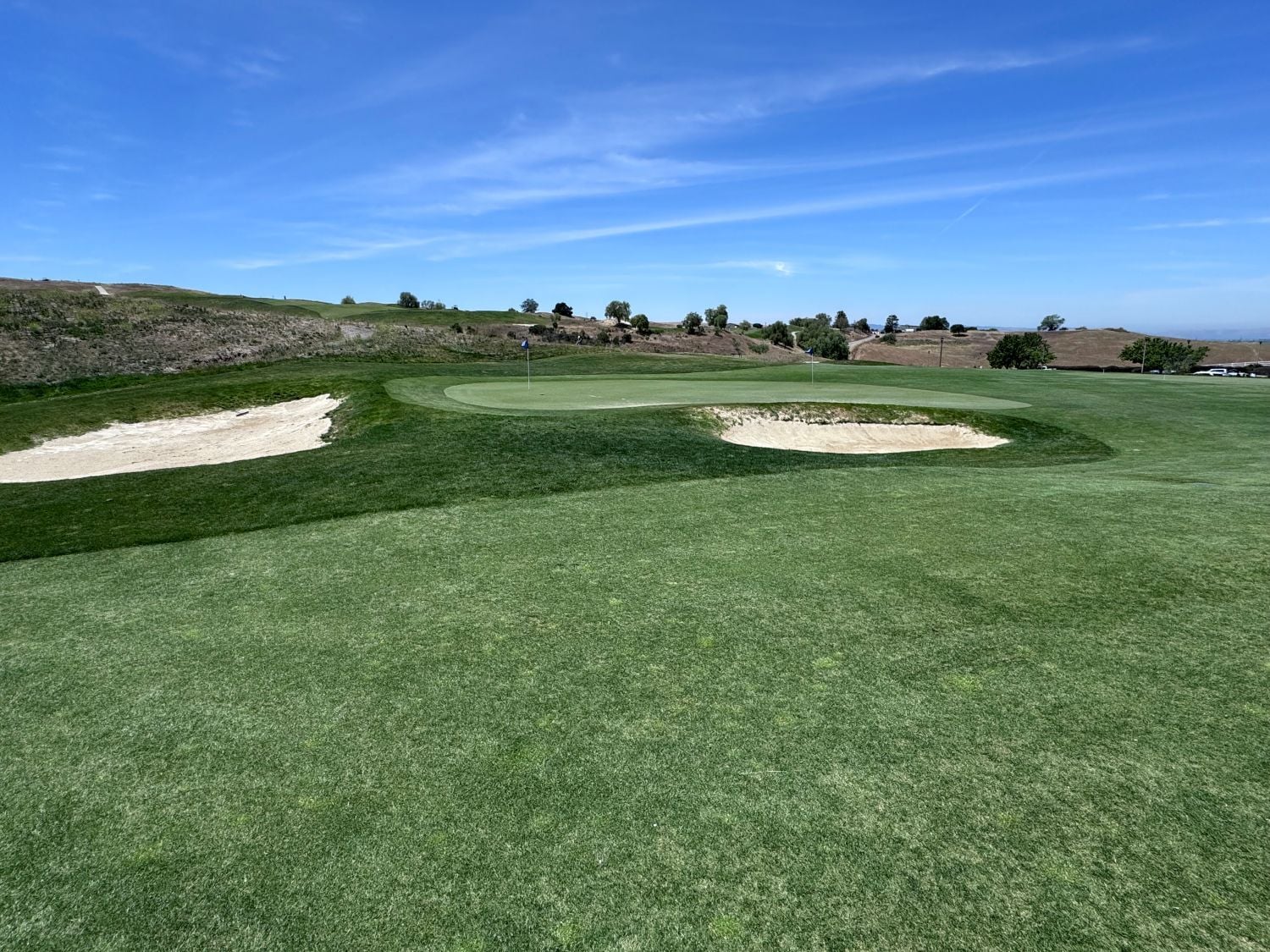
Mike Copp, head pro at Poppy Ridge, understands the importance of dialing practice area conditions to the course. Jay Blasi’s redesign in 2025 included a laser-leveling of the grass range and expansion of the chipping area and practice green. Now golfers can hit to a practice green from 75 yards out or play from a greenside bunker and then turn around and hit from the same bunker to the range with a wood.
“It’s not just a flat lie when you’re at the chipping green,” said Copp, a Hayward native who knows how hills can wreak havoc on a game. “There are various levels you can get to. There's native grass to chip out of. It gives you every aspect.”
“You can put scenarios out there and kind of simulate a round. And I think that's what's going to take you to the next spot: hitting shots that you would potentially experience on the golf course, and not just the basic, flat, bump-and-run that you can hit with 14 clubs in the bag.”
Stan Lal, a retired Tesla worker, recalls when just a handful of golfers would cause a backup on the practice area. “This is great,” the self-taught 10 Handicap Index said of the expansion while carrying a bucket from the chipping area to the grass range.
“It’s just very convenient.”
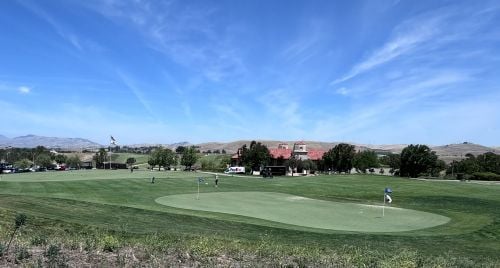
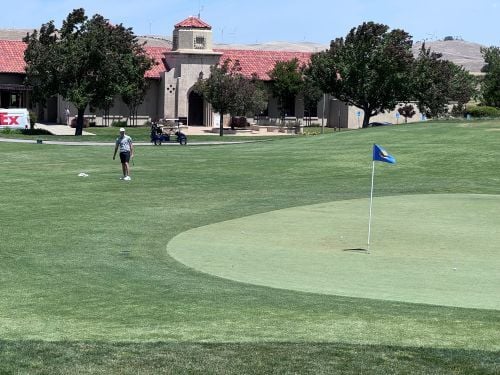
Peng said practicing from 30-to-40 yards is “super important” to achieving that consistency. “Those distances are where you score the most.” The UCLA commit then places alignment tools on the 17,000-foot practice green and pops in her earbuds.
“We want you putting from all over that thing,” Copp said in the clubhouse as the mid-amateurs signed their scorecards. “Using the different breaks, seeing what a 100-foot putt looks like, what going up the hill looks like, then back down. It's a place where you can use your imagination.”
Haggin Oaks Golf Complex—Where Midnight is the Pitching Hour
Perhaps nothing represents the history of Haggin Oaks more than a WPA-era water fountain in an empty field on the 1932 Alister McKenzie design. Before 1950s freeway construction wiped out two original holes, the fountain accompanied the 10th tee box. From our golf cart, Director of Golf Mike Woods points to adjacent Auburn Boulevard Road where the original clubhouse once stood.
In the current clubhouse where a half-century-old skins game congregates on a breezy Memorial Day, tables in the restaurant are adorned with photos and result sheets from Sacramento Opens of yore, when Haggin Oaks head pro Tom LoPresti battled against the likes of Sam Snead and Ben Hogan.
Much of the golden age of golf architecture was bulldozed for shopping centers, parking lots and, a few miles north of downtown Sacramento, Auburn Boulevard. That water fountain became obsolete in the rerouting, but the construction opened space for what became the region’s top performance center.

On this Memorial Day afternoon, toddlers whack golf balls across putting course with flowers, water hazards and sand traps. Siblings play TopTracer games on a range built in the 1960s and sprawl across the stadium-style seating. Their parents escape to a bar and a food truck on the patio. In covered hitting bays with Trackman technology, PGA professionals check launch angles and spin rates while fitting clients for new sets of clubs.
“Wait until nighttime,” Woods says.
When Woods began working part-time at Haggin Oaks in 1990 while a golfer at Sacramento State, the driving range on Fulton Avenue closed at dusk, or just as Sacramento summers became tolerable. The course added floodlights and extended hours.
“That was a game changer,” Woods thinks back. “It's beautiful to come out in shorts and a t-shirt to work on your game. And so that was a complete game-changer for us as far as the range business. Then we found people wanted us to stay open much longer. So we were open till 10 p.m., and that wasn't late enough. Then, well, let's try midnight. That wasn't late enough. And then we said, well, let's go 24 hours a day. And so for 25 years here, in the seven months of the season, we were open 24 hours. We didn't close.”
The transition presented challenges. Could a golf course assemble a graveyard shift? Would new revenue offset the cost of floodlights? “We had to test that and make sure that made sense and it did,” Woods recalls. “And for decades we've had security here at night because we want people to feel safe and we want them to feel like it’s a healthy, welcoming family environment.”
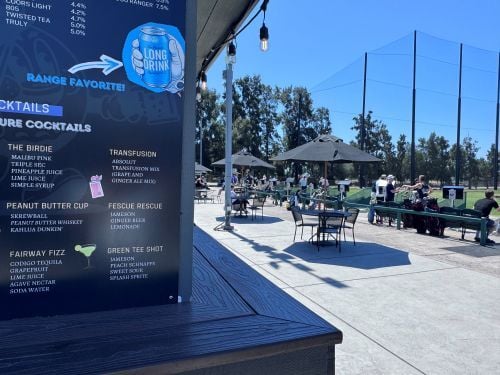
Curfew is now midnight — the pitching hour.
“When the sun goes down,” Woods said, “this real transformation happens. The golfer who comes with their own golf bag, is wearing a golf glove, has their golf shoes on, is working on their game, that mostly goes away. It becomes this entertainment facility at night and you have groups of friends that walk in with one set of clubs or no clubs (there are 35 rental sets).
“Nobody has a glove on. Nobody has golf shoes on. They rent one bucket. They go to one bay. They don't have to know the lingo. They don't have to fit in any way. They can just come out here and have a blast.
On the far end of the two-sided range, which has been extended over years to accommodate longer hitters, a set of bleachers faces a bay devoted to junior clinics. A Gatorade bucket and ball machine welcomes a more taciturn brand of range rat. On the adjacent Academy Holes, a three-hole routing built in 1999, a man dials in his wedge yardages.
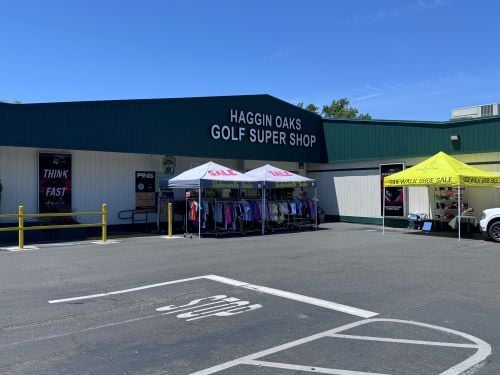
“People love it because it’s the classic no frills driving range,” said driving range manager Chris Isaacks of the back range. “It has a different vibe. Someone who puts their headphones in to work on their game and zen out.”
Haggin Oaks has modernized over the decades, but it hasn’t lost touch with the soul of the game.
Hundreds of middle schoolers tee off on the Arcade Creek Course each week. High schoolers still start from three tee boxes on two courses at 3 p.m.
“Our mission,” Woods said, “Is that the entire community feels they can come out and have fun. We do that in a lot of different ways.”
The Truckee practice facility recently hosted the PGA Tour’s Barracuda Championship and is open mid-May through mid-October. The grass range and putting and chipping greens are available for a daily pass ($45, $25 after 3 p.m., $15 for juniors), with an early Monday close .
Website: tahoemountainclub.com/old-greenwood
The Lucious Bateman Driving Range, named after the pioneering East Bay instructor who led Tony Lema to the 1964 British Open title, is open 6:30 a.m.-8 p.m. (2 p.m. open Tuesdays). The Alameda golf complex has 47 hitting bays with Toptracer technology, along with a grass tees, a short-game area, putting green and the Mif Albright par-3 course. Range buckets start at $8.
Website: coricapark.com/practice