
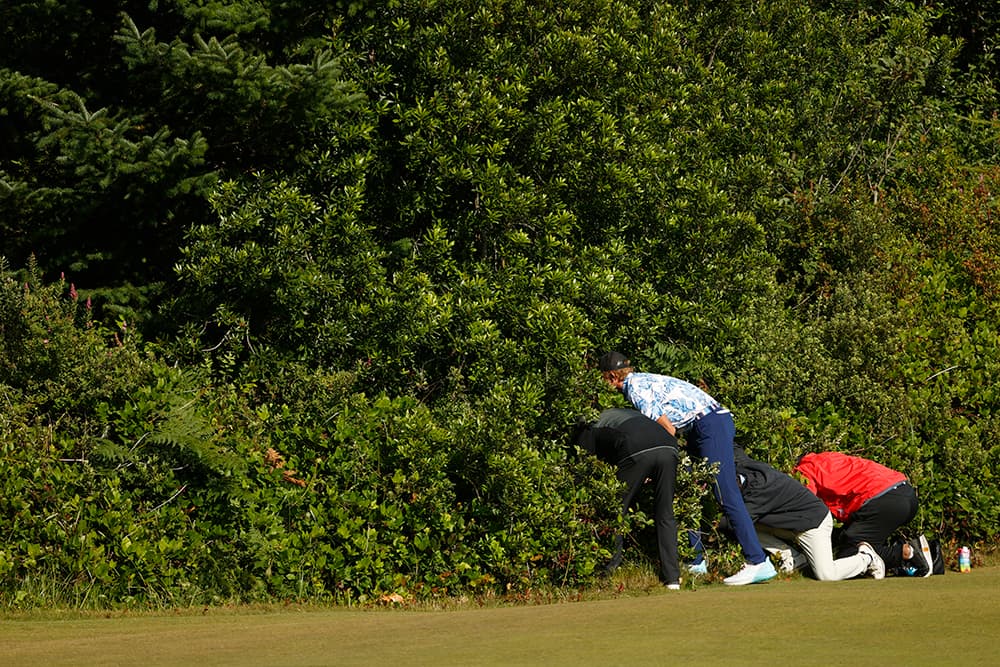
We’ve all been there at some point or another.
You seem to be playing just fine, when on the next hole you spray your shot somewhere you weren’t aiming.
Soon after, things get even worse. You now cannot even find your ball.
You look for 3 minutes to no avail. That Titleist ProV-1 you bought earlier in the pro shop is gone.
So, what exactly happens if you cannot find your ball within the 3-minute window?
If you can’t find your ball within three minutes, it is lost. Because it is lost, you must return to the spot of your previous stroke and play another ball from there for one penalty stroke.
This situation falls under Rule 18.2b: Ball Lost or Out of Bounds: Stroke-and-Distance Relief Must Be Taken
a. When Ball Is Lost or Out of Bounds
(1) When Ball Is Lost. A ball is lost if not found in 3 minutes after the player or their caddie begins to search for it.
If a ball is found in that time but it is uncertain whether it is the player’s ball:
- The player must promptly attempt to identify the ball (see Rule 7.2) and is allowed a reasonable time to do so, even if that happens after the three-minute search time has ended.
- This includes a reasonable time to get to the ball if the player is not where the ball is found.
If the player does not identify their ball in that reasonable time, the ball is lost.
What to Do When Ball Is Lost or Out of Bounds
If a ball is lost or out of bounds, the player must take stroke and distance relief by adding one penalty stroke and playing the original ball or another ball from where the previous stroke was made (see Rule 14.6). Basically, go back to the spot where you hit your last shot.
But there is an Exception: The Player May Substitute Another Ball Under Other Rule When It Is Known or Virtually Certain What Happened to Ball: Instead of taking stroke and distance relief, the player may substitute another ball as allowed under a Rule that applies when their ball has not been found and it is known or virtually certain that the ball:
These exceptions can help you, if they apply:
- Came to rest on the course and was moved by an outside influence (see Rule 9.6) or played as a wrong ball by another player (see Rule 6.3c(2)). For example, a squirrel grabbed your ball, or your spouse accidentally hit your ball by mistake.
- Came to rest on the course in or on a moveable obstruction (see Rule 15.2b) or an abnormal course condition (see Rule 16.1e). For example, your ball ended up bouncing into a cart.
- Is in a penalty area (see Rule 17.1c), or
- Was deliberately deflected or stopped by any person (see Rule 11.2c).
NOTE: Your club may use Model Local Rule E-5 which allows a Committee to provide an extra relief option that allows a player to play on without returning to the location of the previous stroke. This option allows the player to drop in a large area between the point where the ball is estimated to have come to rest or gone out of bounds and the edge of the fairway of the hole being played that is not nearer the hole. The player gets two penalty strokes when using this relief option. This means that the relief is comparable to what could have been achieved if the player had taken stroke-and-distance relief.
As you can see, if you do happen to lose a ball—and you will if you play enough—you have options. Remember, the Rules of Golf are there to help you!