
Rules of Golf 101: In Play Or Not in Play? That is the Question
April 10, 2026 / by NCGA Staff
By Luke Guenther
The wonderful sport of golf, on paper, appears to be a simple and straightforward game. You start at the teeing area and use a club to hit a ball towards a hole, until you make it into the hole. That’s it.
However, if you’ve ever actually played the game, you’ll know that a lot can happen between your tee shot and getting the ball into the hole. All of a sudden, that immaculate fairway is obscured by trees, and guarded by bunkers and tall grass. The putting green is perched up on a hill with severe slopes on all sides, leading down to a pond that will engulf your ball and cause it to be forever lost in a watery grave. These are just some of the challenges that face us when we attempt to traverse the game. Many of these things can and will get in our way, and ultimately, the Rules of Golf give us tools for when we can’t always live by the principle of “playing the ball as it lies”. In doing so, it becomes important to know when we have a ball in play and when we no longer do.
Take for example, when we hit our ball out of bounds. It’s something that if you haven’t done yet, then you’ve likely not been playing golf long enough. Generally speaking, we put a ball In Play on each hole when we make a stroke at it from the teeing area. If it comes to rest out of bounds, well then we no longer have a ball In Play, and the Rules require us to now put another ball In Play. The “tool” given to us for this scenario comes from Rule 18 and it’s called “Stroke and Distance”. We simply put another ball back In Play from where we last made a stroke and add a one-stroke penalty to our score for that hole. This can happen in the teeing area (like in our scenario here), but also in the fairway or even on the putting green. We always have the ability to enact Stroke and Distance and play from where we last made a stroke.
Sometimes we take our ball out of play purposefully. Have you ever taken relief from a cart path? Or maybe a sprinkler head? Once we lift our ball up to take relief, we have taken our ball out of play. Then, the second that we drop it, it becomes our ball In Play again. Rule 16 is our “tool” we use for this situation, and it gives us free relief from Immovable Obstructions, Ground Under Repair, Animal Holes, and Temporary Water.
Knowing whether your ball is In Play or not In Play becomes very important when we deal with certain Rules.
Say we hit our ball into a wooded Penalty Area. We know it went in the Penalty Area and we go drop a ball within two-club lengths of where we estimate it crossed the red paint line. Then perhaps our playing competitor points out that he sees our original ball in the Penalty Area by a tree, but in a playable spot. At this point, we’ve put a new ball In Play, as allowed under the Rules. The ball that we originally hit is no longer our ball In Play, which makes it a Wrong Ball and so we would need to complete the hole with the ball that we dropped outside the Penalty Area.
Generally speaking, any ball that is not the player’s ball In play is considered a Wrong Ball and if we play a Wrong Ball it comes with a two-stroke penalty and we are required to fix our mistake (Rules 6.3c). So how can we be sure we don’t do this? Well, it was once explained to me by a USGA staff member to think of your ball as a “glow ball”. It’s green when it’s In Play, and red when it’s not In Play (aka a Wrong Ball).
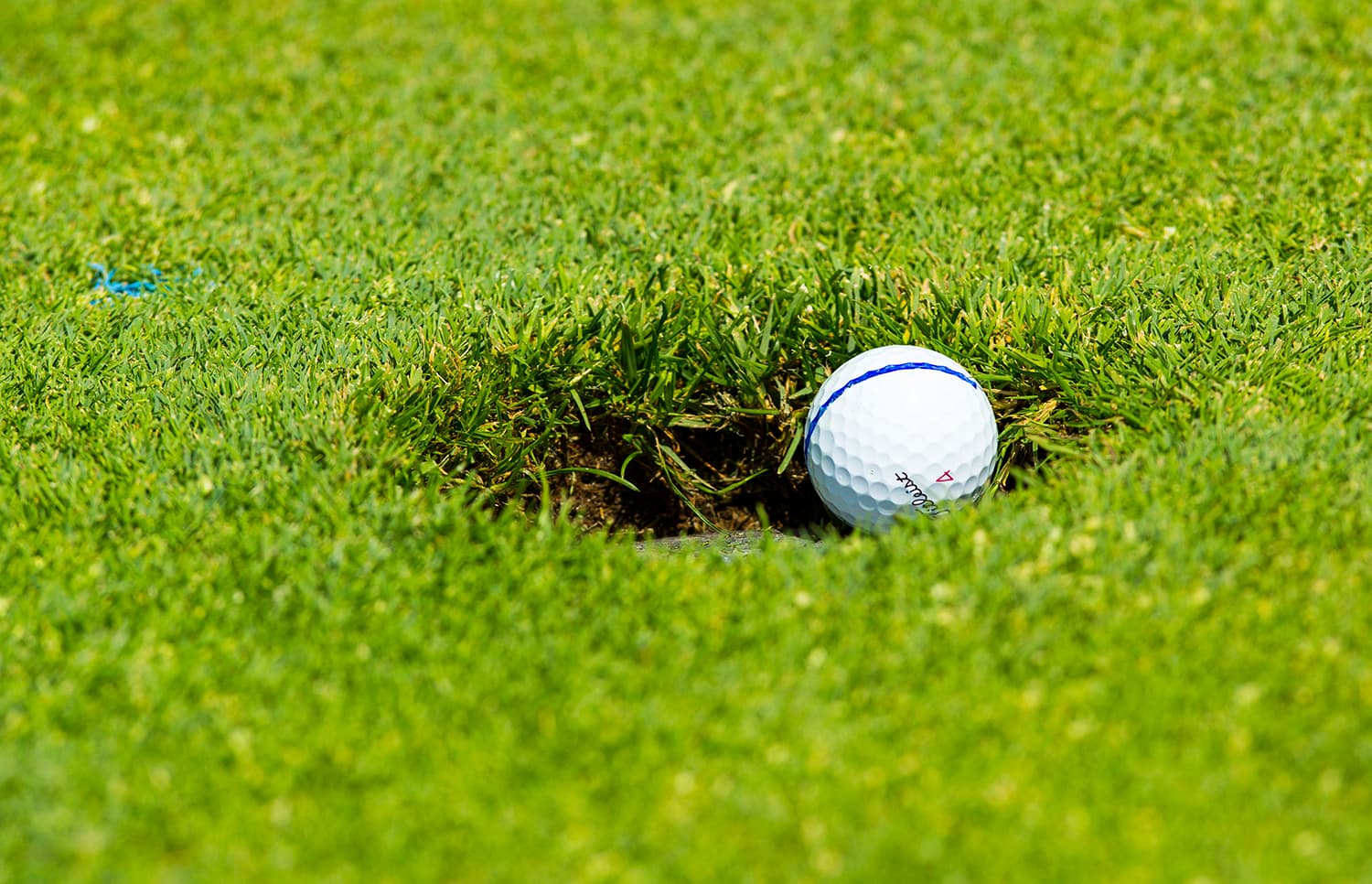
Let’s play a hole together and think about it like this. We tee off from the teeing area (ball becomes green when we make a stroke at it). It flies 260 yards down the fairway and remains green the whole time. We walk up and find it on a sprinkler head and we know that we get relief from sprinkler heads. So we pick up our ball (now it becomes red). We drop it in our relief area (becomes green when it leaves our hand). We hit it left into the trees and walk over to start searching for it (the ball is green, but turns red right when our 3-minute search time expires). We then drop a ball from where we last played (ball turns green when it leaves our hand). We play it to the putting green. On the putting green, we mark the spot and pick up the ball (turns red because we’ve lifted it) and then we clean it and place it back on its spot (ball turns green when we let go). We then putt it into the hole (ball turns red when it comes to rest in the bottom of the hole). And we’re done! Remember, all other balls out on the course (other player’s balls, range balls, a stray ball) are also red to us because they are not our ball In Play.
So next time you’re out on the course and you ask yourself the question: In Play or Not In Play? Just think back, is the ball red? Or is it green?