
This story originally appeared in the September 2026 issue of NCGA GOLF Magazine
Day Trips – Davis
Story and Photos by Ted Johnson
When it comes to Davis, in high school many knew it as just a blur on the way to the ski slopes. A little later it was an obvious place for a college application. Now it’s recognized as an attractive suburb of the state’s capital and home to arguably the most underrated university in terms of its place in the country’s economy.
Davis, you ask? Yes, Davis.
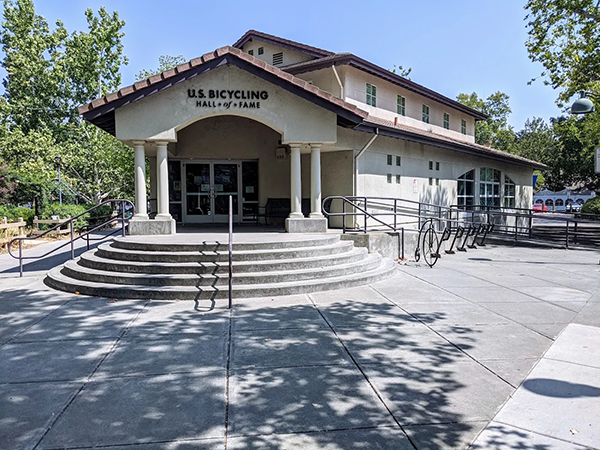
Most noteworthy, of course, is that thanks to installing bike lanes in 1967, Davis calls itself the "Bicycle Capital of America," Indeed, with a flat terrain, a grid layout and a youthful population of about 28,000 undergrads at UC Davis, cycling ranks as the most popular means for getting around.
As a Berkeley grad, it’s easy for me to denigrate this campus that opened in 1908 as the “University Farm.” In that role, UC Davis has played a critical role in developing California’s vast, rich agricultural offerings. In the late 1800s, UC soil scientists led the foundational research that showed farmers how to remove salts from the alkali soils in the Central Valley, transforming barren land into one of the world’s most productive farming regions. And there would be no California wine industry if UC researchers had not helped resurrect vineyards after Prohibition nearly destroyed it.
Naturally, the campus is the locus of the community, though the school’s central block of buildings lack – my humble opinion – the classic late 1900s architecture found in Berkeley and Los Angeles. Academically, UC Davis’ schools of horticulture and agricultural sciences are the best in the country. Its management, medical and law schools are first-rate. And there’s levity: among the decorative gardens you come across the “Egghead” sculptures” by artist Robert Arneson.
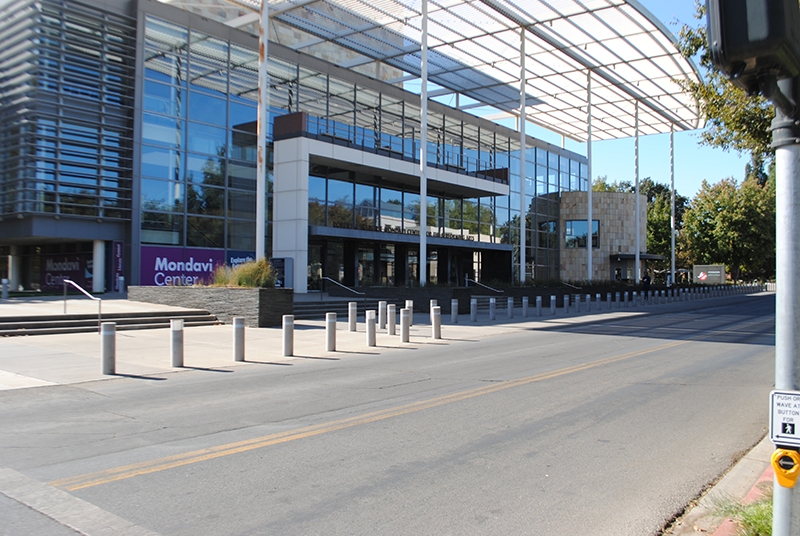
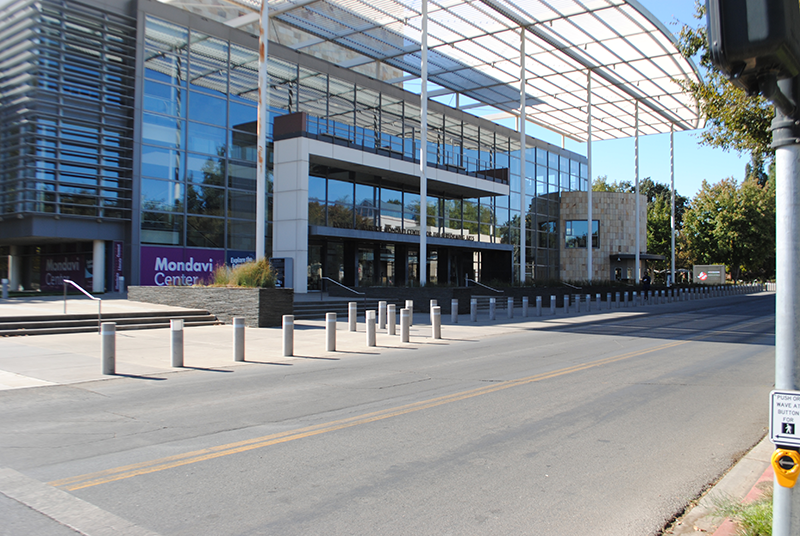
Now, the “University Farm” label takes a back seat to high-end culture. The impressive Robert Mondavi Performance Arts Center brings in major musical, theatrical and cultural events from around the world. The stunning Shrem Manetti Museum has been honored as one of the best museum buildings in the last 100 years. You can “enhance your understanding of wine, brewing, and food sciences” (university’s wording) in the Mondavi Institute for Wine and Food Science. Online classes are available for aspiring oenologists.
When Wild Horse GC opened in 1991, its promise in this progressive setting seemed quite high. Designed by Jeff Brauer, it’s a fantastic course that unfortunately has suffered. General Manger Charlie Klein said the course has had six owners in its 26 years, and though a spike in play during the pandemic that brought about 36,000 rounds annually, the course is down to about 30,000.
Moreover, Klein admits that the course is “way behind” in deferred maintenance, which is another way of saying that such things as turf management is lacking, some bunkers need to be re-worked, and a “irrigation survey” (quite costly) is needed. And you see what he means on the first tee.
The par-4 first offers an expansive fairway riddled with numerous strains of turf and native grasses. The bunkers bring challenges but some edges are collapsing, and on other holes some showed signs of pooled water – lack of drainage. To the eye on this hot summer day, the course looked brown and gasping for care. And yet.
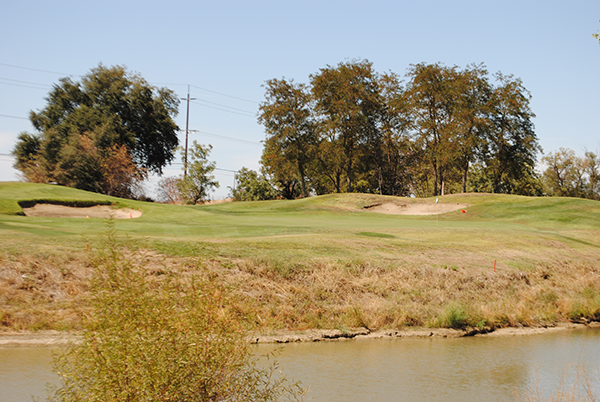
The layout is extraordinary if not unique that the first two holes start across from the parking lot, and then holes 3-18 divide time between suburban neighborhoods and open space. As unkempt the fairways looked – they were mown and firm – the greens were large, smooth and fairly fast – a tribute to the groundskeeping team and Klein.
Brauer’s routing brings you into junctions behind greens with two or three direction signs, which helps make it more walkable despite its spread-out footprint and eliminates an “out-and-back” feeling. Also, the course offers perhaps the biggest difference in tee boxes, with holes like the par-3 14th measuring 185 yards from the back or “red” tees to 117 yards from the white. Often, there’s as much as an 80-yards gap in the men’s offerings, more so for the very forward tees.
As someone who played this course about 18 years ago, the contrast is saddening. First and foremost, such entities are businesses and this one had to live through the economic downturn of 2010 to the pandemic a decade later. And the local demographic seems more attuned to sports with two wheels. Though clubhouse and pro shop are good, there is no facility for outside events like weddings or corporate gatherings. The best way to help is to play and play a lot.
“It was just in a weird place,” Klein said, “in that were on the edge of Davis, so some wonder if we’re in Woodland or Davis. And there has been a lot of change over time, and there are ideas of what to do – whether this continues as 18 or nine holes, unless we get a lot of help.”
A day in Davis with good golf can be very satisfying. The post-round culinary offerings are very attractive, as expected for a quaint college town of bookstores, coffee shops, and brew pubs. But when it comes to dining, you can go from Burgers and Brew all the way up to Mustard Seed, a traditional steakhouse resplendent in mid-20th century décor. And like all California college towns, there’s always sushi (try Mikuni) and good Mexican food (Guadalajara Taqueria is outstanding).
A visit to Davis can, in one day, bring you quality golf, a chance to scour the shelves at Logos Books, a symphony concert at the Mondavi center, and top it off with myriad food offerings. Not bad for an old farm.