
This article originally appeared in the November issue of NCGA Golf Magazine
Combining Science and the Swing
Adam Johnson of Golf Solutions with Emily Van Buskirk
From banker to one of the few dual-certified Level 3 Titleist Performance Institute trainers in the country, Adam Johnson’s path to golf fitness mastery wasn’t exactly planned — but it was purposeful. What began as a personal journey to improve his own health evolved into a full-time passion for helping golfers of all ages move better, feel stronger, and play longer. Through Golf Fitness Solutions, based in Sacramento, Johnson combines science-backed training with a deep understanding of the golf swing - proving that performance gains come not just from strength, but from movement. In this conversation, he shares how his journey began, what most golfers get wrong about their bodies, and the simple drills that can make a world of difference in your game.
Question: What is your golf origin story?
Adam Johnson: I was fortunate enough to have my grandfather drag me out onto a golf course at around seven years old, and I immediately fell in love with the game. By my early teens, I was probably more interested in finding golf balls and chasing fish around in ponds, but whether I was feeling competitive or not, I always enjoyed being out on the course. Now, I play to a scratch or better most of the year — but the love for the game hasn’t changed a bit.
Q: How did Golf Fitness Solutions come about?
AJ: GFS actually kind of happened by accident. In my late twenties, I had some health concerns that forced me to make drastic changes to my life. I was out of shape, I drank too much, and I smoked.
At 29, I decided to quit drinking and smoking — and with all that new free time, I started spending my days in the gym. About six months into that transition, I realized I had no desire to go back into banking. My friend Wayne suggested I look into becoming a trainer… so I did.
About six months after that, knowing that I was an avid golfer, my friend Jody told me to check out the Titleist Performance Institute, and the rest is history. I’m now one of a handful of trainers with both Level 3 Fitness and Level 3 Golf Certification, and I’m currently adding the rest of TPI’s programs in Power, Medical, and Junior.
Q: What are the most common questions or issues you’re approached about when it comes to clients’ golf games?
AJ: This one really depends on the client, but generally:
- From my pros: “How can I be more consistent?”
- From my amateurs under 60: “Why does my low back hurt when I swing?”
- From my players over 60: “How can I add more distance?”
Golf Fitness, when done right, addresses each of these — though not always in the way people expect. Most people are much stronger than they realize, but as we age and develop poor movement patterns, our ability to recruit muscle and generate power diminishes.
Our biggest opportunity is helping people learn how to move better and more efficiently. That's where real performance gains come from. Strength isn’t usually the problem — movement is.
Q: Why is a Handicap Index so important?
AJ: A Handicap Index is an excellent measure of how you’re improving or declining in your game. When it drops, you know you’re playing well. When it climbs, you know something’s off.
But maybe the best part is that it gives a scratch golfer and a 25-handicap player a way to have a fair competition. There aren’t many other sports where that’s possible.
Q: What’s good, generic advice that helps all golfers?
AJ: Stop trying to self-diagnose. One thing I see all the time is players telling me they’re “over the top” or “pulling their head up.” While those might be true, there’s always an underlying reason. Sometimes it’s as simple as learning a new pattern, but 99% of the time, it’s a mobility or stability issue in the lower body that’s being ignored. Without proper mobility, your body will try to create it somewhere it shouldn’t — like your low back. That’s where injuries happen.
If you want to play your best golf long-term, fix how your body moves first, and the swing will follow.
“Your swing isn’t broken — your body just can’t do what you’re asking it to.”
Q: What’s your go-to nutrition on the golf course?
AJ: I’m not sure there’s a better snack than beef jerky out on the course — easy, clean protein. But always, and I mean always, make sure you’re hydrating — especially as we move into the cooler months when it’s easy to forget.

Q: Is there a good drill or tip you have that would benefit all golfers?
AJ: Two of my favorites are PNF Marches and the TPI “Butt-Against-the-Wall” Drill. Both are simple, take less than a minute to perform, and can make a huge difference in how you move and swing.
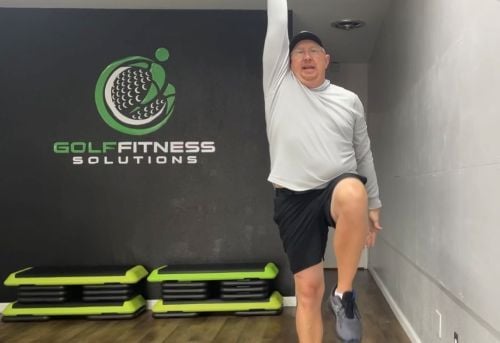
PNF Marches are great for waking up your hips, core, and glutes while improving sequencing between your upper and lower body.
Here’s how to do them:
- Stand tall with your core braced and your arms hanging naturally by your sides.
- Lift your right knee and left arm at the same time — like a slow, controlled march.
- Hold for one second at the top, feeling your glute and core engage, then lower and switch sides.
- Continue alternating for 20–30 reps, focusing on balance and control rather than speed.
- You should be driving from the foot on the ground more than you’re pulling with the knee in the air.
This teaches your body to coordinate opposite sides — exactly what happens in a powerful, efficient golf swing.
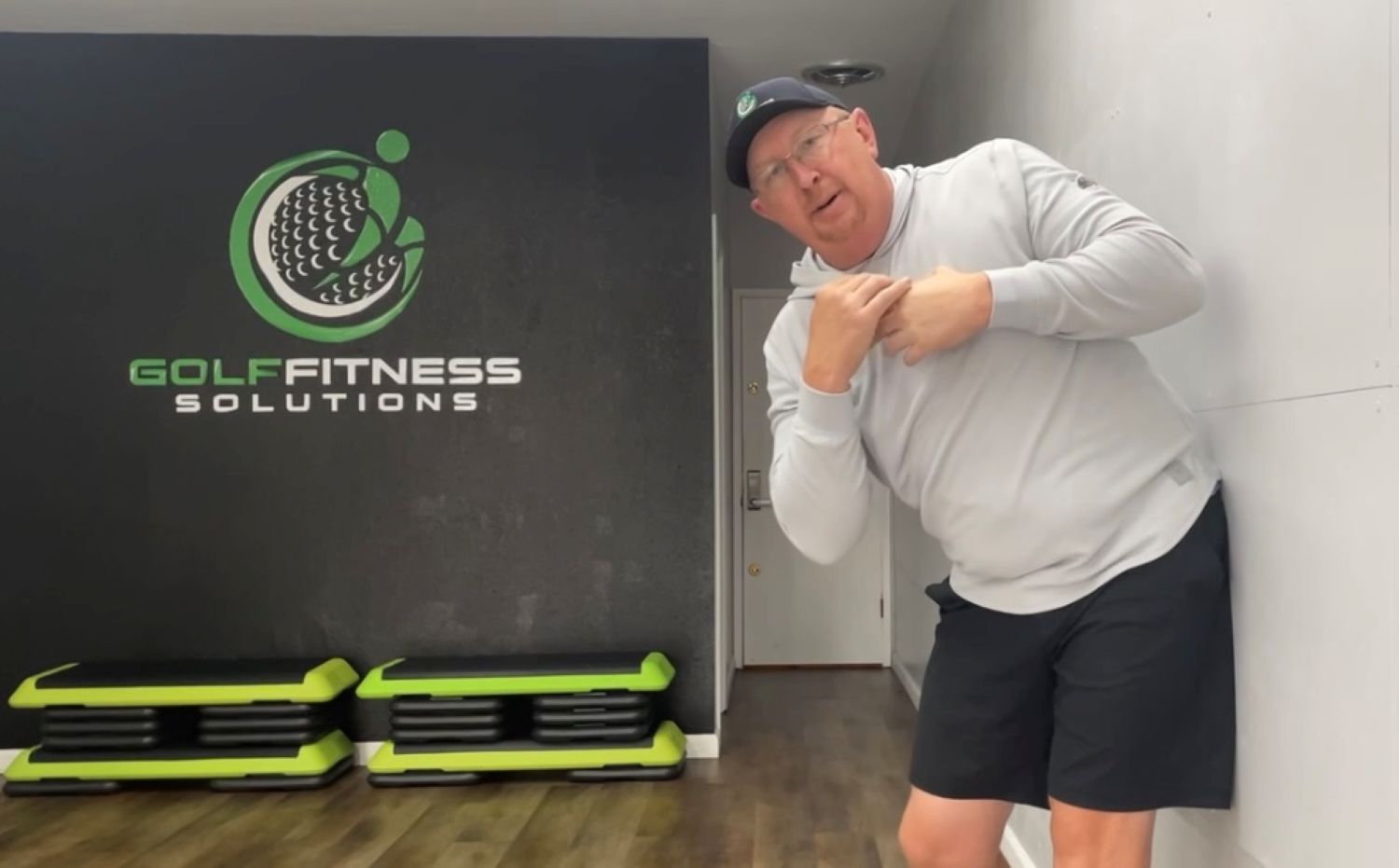
The Butt-Against-the-Wall Drill is one of my all-time favorites for teaching proper hip movement and rotation.
Here’s how to do it:
- Stand with your heels about six inches from a wall and your glutes lightly touching it.
- Cross your arms over your chest and move into your golf posture.
- Make a slow backswing, creating firm pressure with your right glute against the wall.
- As you transition and move through your downswing, keep that contact and feel your left glute driving into the wall — almost like you’re trying to knock it down.
This trains the proper hip depth and rotation that keeps your posture stable and your swing powerful.
If you can master those two movements, you’ll move better, swing more efficiently, and protect your back at the same time.