
This article originally appeared in the August issue of NCGA Golf Magazine
By Gary McCormick
Most golfers know about the GHIN (Golf Handicap Information Network, aka “handicap”) system, and if they carry a Handicap Index® they are familiar with seeing the course rating and slope numbers for the course when they post a score – but do they know how those numbers are determined?
Well, the course rating and slope numbers come about thanks to course raters, dedicated men and women who go out and play golf courses, and applying knowledge, expertise – and some mathematics – set the course rating and slope values which are used, in concert with players’ scores, to determine handicap rankings.
Sounds like a great volunteer gig, doesn’t it, involving as it does playing lots and lots of golf, on every imaginable type of golf course from munis to pricey resort courses and elite private courses. Well, it definitely is, but there are some qualifications involved – and one of the most qualified, and experienced, course raters in NCGA territory is Pete Pizzino, of Alameda.
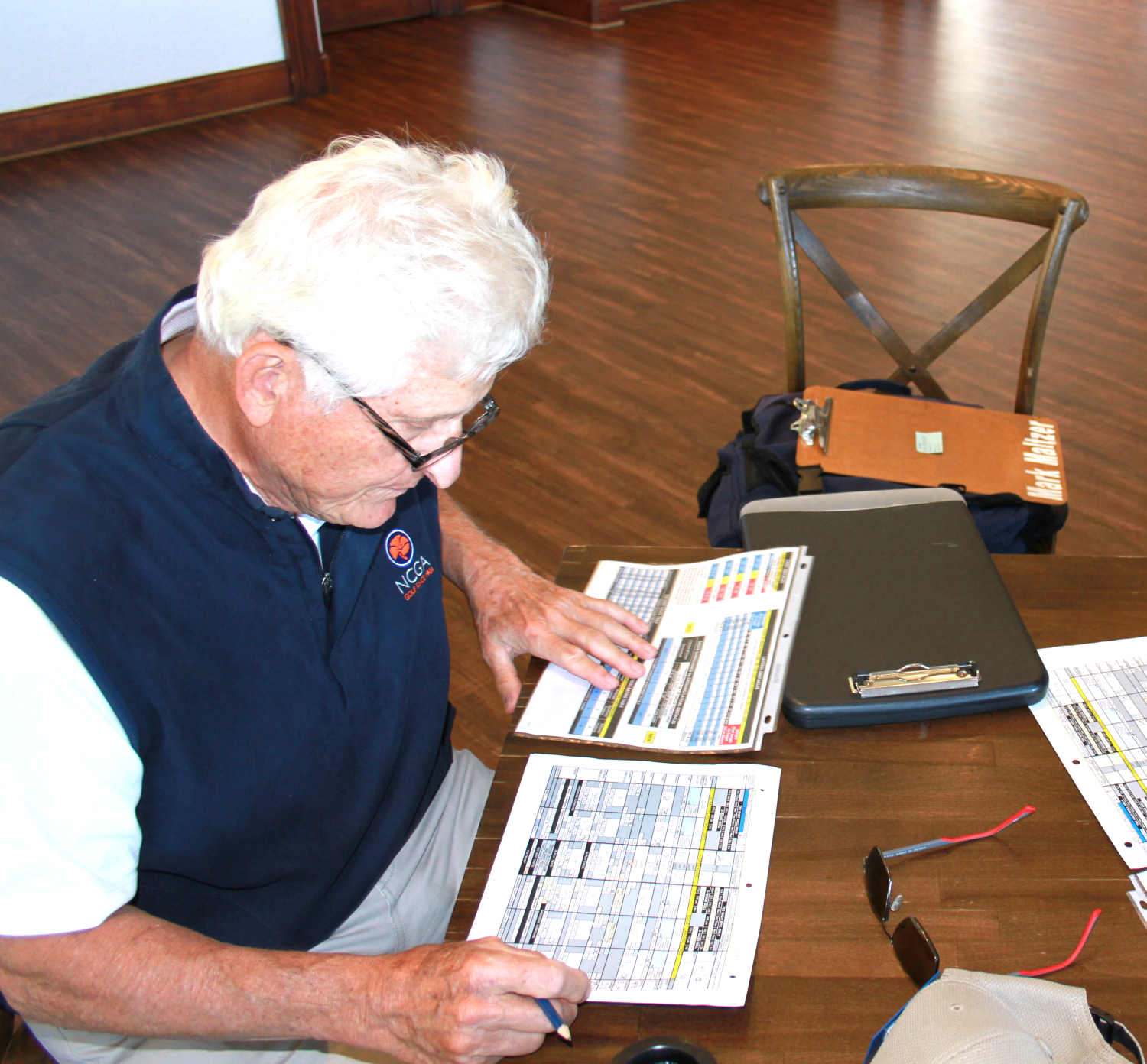
Pizzino first became involved in the official side of the game of golf in 1978 as a tournament official, a “redcoat” as they were called back then. In the course of his work as an official he became interested in becoming a course rater. His experience and near-scratch Handicap Index qualified him for the role; he applied and was accepted, and in 1981 he began rating courses.
According to the USGA, a course’s rating “represents the score a scratch player, with a Handicap Index of 0.0, should achieve on a golf course under normal course and weather conditions.” Course rating is a bit more involved nowadays than it was when Pizzino started back in the early 1980s, but then the process was something like this: A group of ten raters, all of whom played off scratch or very near scratch, would go out and play a course, recording their scores for each hole. The highest two and lowest two scores for each hole would be thrown out, and the middle six averaged to calculate the expected score, or rating.
In those days only scratch scoring was considered in a course rating, but in 1981 Pizzino was involved in the development of the slope rating, which was the brainchild of USGA staff member Dean Knuth and Dr. Richard Stroud, a former director of the NCGA.
“It was very judgmental; you were only looking at it from a scratch standpoint, the bogey accountability wasn’t there,” Pizzino says, “I was involved with the first study for slope, where Dean Knuth and Dick Stroud and a few others started having home-and-home tournaments, and would see how an Olympic Club Ten would play a Sunnyvale Ten – one being considered an easy course and one a more difficult course – and noticed that handicaps were not portable.”
Slope is determined by comparing the scratch rating of a course to a bogey rating, the bogey rating being the score that a bogey player (20-handicap for men, 24 for women) should achieve under normal course and weather conditions. The greater the difference between those scores, the higher the slope value of the course.
“We went through the ’80s with a lot of variations of it. By about ’84 we had coordinated with Southern California, looking at a system of incorporating course obstacles into it, and as slope became more solid they implemented it in 1989.”
Now this is where the rest of us get envious, as Pizzino continues: “We had to rate every golf course in Northern California in one year. I took a year off from work, and I probably did 40 golf courses in that one year, in terms of getting the ratings done.”
Pizzino has enjoyed being a part of the development of the course rating and slope system, and in addition to the perk of playing the courses, “(r)epresenting the NCGA – meeting the pro, meeting the superintendent, talking with people who have some common interests. I enjoy doing it.”
As for standout moments in his career as a course rater, Pizzino says, “Well, you can take all the top golf courses that you’ve been able to rate, and those are something that you can cherish – whether its Cypress Point or Pebble Beach Golf Links or San Francisco Golf Club, I could go on and on. I’ve rated every golf course, probably within 100 miles of where I live.”
“You do what you enjoy, it’s as simple as that. I’ve enjoyed golf and I’ve enjoyed being around golf. Being part of the NCGA committee has helped me meet a lot of people, and those are relationships that I have cherished.”
One particular moment that stands out for Pizzino came about when it came time to rate the rehabilitated Harding Park Golf Course.
First opened in 1925, Harding Park has fallen into disrepair by the end of the 1960s, a victim of budget cuts, and in 1998 the fairways were actually used as a parking lot for the U.S. Open at the nearby Olympic Club. Frank “Sandy” Tatum, a prominent San Francisco attorney and a former president of the USGA, pulled together support from political leaders, local businesses, and the PGA Tour that resulted in a $24 million restoration of the historic layout in 2002–2003.
When Pete showed up at Harding Park, along with other raters, to assess the course before it was open to the public, and found Tatum there, with a select group of people who were there to play the first rounds on the rejuvenated layout. When Pizzino asked Tatum who he was going to be playing with Tatum replied, “I don’t know” – so Pizzino said, “Why don’t you play with us?”
They put Tatum in the first group, and he very fittingly hit the first ball of the first round on the new course. Pizzino played 18 holes with Tatum, and when he took a couple of clubs out to Tatum while he was contemplating a shot, Tatum told him, “You don’t have to do that,” to which Pizzino responded, “It would be an honor to do that for you.”
For almost 50 years now, Pizzino has been a vital part of the services provided to golfers by the NCGA, and we honor and thank him for that.
Interested in becoming an NCGA volunteer? Please visit our Volunteers website page at ncga.org/about/volunteer